JOURNAL · TAI CHI PRINCIPLES & MARTIAL ARTS
Watch a Tai Chi movement and your eyes will probably follow the hands. But the hand is often where the movement becomes visible—not where it begins. In Tai Chi, we learn to initiate movement through changes in weight and our relationship with the ground, then allow that movement to travel through the whole body.
IN THIS ARTICLE
Where Does a Tai Chi Movement Begin?
The Hand Is Not Necessarily the Beginning
The First Momentum: Shifting Weight and Gravity
What Does the Ground Have to Do With It?
From the Feet to the Fingers
A Simple Test: The Single-Arm Swing
What Does “Grounded” Really Mean?
Why This Matters in Martial Application
Why This Matters Outside Martial Arts
How to Practice Movement From the Ground
Where Did the Movement Really Begin?
Where Does a Tai Chi Movement Begin?
Here is a simple question I often ask when teaching Tai Chi:
Where did the movement begin?
It sounds like an easy question.
If you see my hand move forward, you might say:
“Your hand.”
If you see my arm swing to the side, you might say:
“Your arm.”
Visually, that makes sense.
But Tai Chi asks us to look at movement differently.
The part of the body that moves most obviously is not necessarily the part that initiated the movement.
A hand can be the final expression of a movement that began much earlier somewhere else in the body.
For me, two questions are especially useful when examining a fundamental Tai Chi movement:
Where did the movement begin?
Did the whole body participate?
Those two questions can reveal a great deal.
The Hand Is Not Necessarily the Beginning
Most of us are very good at moving individual body parts.
If I ask you to raise your right hand, you can simply contract the muscles around your shoulder and arm and lift it.
If I ask you to push something, your first instinct may be to extend your arm toward it.
There is nothing inherently wrong with either action.
But Tai Chi is interested in another possibility:
Can the visible movement of the hand be part of a larger movement of the whole body?
Imagine pushing a heavy door.
If you stand far away and try to push it using only your arm, you quickly discover the limitation.
Naturally, you begin organizing more of yourself behind the action.
Your feet interact with the floor.
Your legs support you.
Your center shifts.
Your torso participates.
The arm becomes part of something larger.
Tai Chi trains this relationship deliberately, even when the movement is slow and there is nothing heavy in front of us.
The First Momentum: Shifting Weight and Gravity
In my teaching, I often use a simple principle:
The first momentum of a Tai Chi movement comes from a change in weight and gravity.
This does not mean that every Tai Chi movement is mechanically identical.
It is a training principle.
Before immediately moving the arm, notice what happens if you first allow the body’s weight to change.
You may sink slightly.
You may shift from one foot toward the other.
You may turn around your center.
That change reorganizes the body before the hand completes the visible movement.
This connects directly with Song (鬆).
If we reduce unnecessary muscular tension, we eventually face an interesting question:
If I am not going to force my arm to move, what can begin the movement?
One answer is gravity.
In What Does “Move Like Water” Mean in Tai Chi?, I used water as an example.
Water does not need muscles to flow downhill.
It responds to gravity.
Human movement is obviously more complicated. We need muscles to support, control, and direct our bodies.
But water gives us a useful question:
Can we cooperate with gravity instead of treating every movement as something we have to manufacture through isolated muscular effort?
What Does the Ground Have to Do With It?
If gravity draws our weight downward, the ground is what prevents us from continuing downward.
This relationship is easy to overlook because it is present every moment we are standing.
But try pushing a heavy object while standing on a slippery surface.
The importance of the ground suddenly becomes obvious.
Your hand may be touching the object, but the success of the push depends partly on what is happening far away from the hand—at your feet.
In Tai Chi, sinking and shifting change the pressure and weight distribution through the feet.
The body then organizes around that changing relationship with the ground.
This is why “grounded” in Tai Chi should mean more than simply imagining that your feet are heavy.
It is a physical relationship.
Your feet are where your body meets the surface supporting you.
What happens there affects what can happen everywhere above them.
From the Feet to the Fingers
Once movement begins through a change in weight and the relationship with the ground, the next question is whether the rest of the body can participate.
I often describe the pathway in simple terms:
feet → legs → waist → spine → shoulder blades → shoulders → arms → hands
This should not be interpreted as a rigid checklist in which one body part mechanically fires after another.
The body is more complex than that.
The sequence is useful because it changes where we place our attention.
Instead of thinking:
“Move my hand.”
we begin thinking:
“How does this movement belong to my whole body?”
Over time, the sequence should feel less like separate pieces and more like one connected action.
The hand may be where the movement appears, but the feet help give the movement its root.
A Simple Test: The Single-Arm Swing
One of the simplest places to explore this principle is an arm swing.
At first glance, an arm swing hardly looks like serious Tai Chi practice.
It may even look like a warm-up exercise.
But the external appearance is not what determines whether we are practicing Tai Chi principles.
Try swinging one arm by deliberately moving the arm back and forth from the shoulder.
Notice the feeling.
Now stop.
Instead of beginning with the arm, allow your weight to sink and shift.
Let that change travel through your legs and center.
Allow the torso to respond.
Then let the arm swing as part of that larger movement.
The arm is still moving.
But the source of the movement feels different.
This is why fundamental exercises are so important in my teaching.
A simple movement gives us fewer places to hide.
We can ask very clearly:
Did I swing my arm?
or:
Did my whole body create an arm swing?
Those are not the same thing.
What Does “Grounded” Really Mean?
“Grounded” is another word frequently used in Tai Chi.
Unfortunately, it can become vague very quickly.
Sometimes people try to look grounded by bending their knees more deeply, lowering their stance, or imagining themselves becoming extremely heavy.
But being lower is not automatically being more grounded.
You can sit very low in a stance and still have poor structure.
You can also become so tense in your legs that changing direction becomes difficult.
For me, grounding is more useful when understood as a relationship:
Can you clearly feel how your weight is being supported through the feet, and can the rest of your body remain organized around that support?
This relationship should not imprison you.
It should make movement possible.
A tree has roots, but Tai Chi is not asking us to become a tree.
We have feet.
We need to move.
So our root must be capable of changing.
When weight shifts from one foot to another, the relationship with the ground changes with it.
Being grounded in Tai Chi therefore does not mean being permanently fixed to one place.
A useful root does not prevent movement. It gives movement somewhere to begin.
Why This Matters in Martial Application
The martial context makes the difference between isolated and whole-body movement easier to understand.
Imagine that you feel your training partner becoming momentarily off balance.
Your first instinct may be:
Push now.
So the arms rush forward.
The hands may reach the target quickly.
But the rest of the body may not yet be organized behind them.
In Tai Chi, reaching the target first is not necessarily the same as delivering an efficient whole-body action.
The question is whether the push remains connected to your base.
Can you maintain Song rather than tightening your shoulders?
Can the change in your feet and weight participate?
Can the legs, center, torso, and arms act together?
This is one reason push-hands practice can be so revealing.
A movement that feels powerful when performed alone may behave very differently when another person applies force back into your structure.
The partner gives you information that empty air cannot.
You discover whether your hand is truly connected to the ground—or whether it only looked connected when nobody challenged it.
Why This Matters Outside Martial Arts
You do not need to practice push hands to experience the relationship between the ground and whole-body movement.
Everyday life gives us examples constantly.
A subway car suddenly accelerates.
You step onto uneven ground.
You push open a heavy door.
You pull a suitcase.
You lose your balance and have to recover quickly.
In each situation, what happens at the feet influences what happens above them.
This is also one reason slow Tai Chi walking can be deceptively difficult.
Normal walking often happens automatically.
Tai Chi slows the transition down enough for us to observe it.
Where is my weight now?
When does one leg become empty enough to step?
Can I stabilize before transferring weight?
What happens to my torso while my feet change roles?
These are fundamental questions about movement, not just martial arts.
How to Practice Movement From the Ground
You do not need an advanced Tai Chi form to investigate this principle.
In fact, a simpler exercise may be better.
Try a single-arm swing.
- Stand comfortably.
Feel how your weight is distributed through both feet. - Do not begin with the arm.
Before moving it, notice your relationship with the ground. - Allow a small sink or weight shift.
Do not exaggerate it. Feel how pressure changes through your feet. - Let the center respond.
Allow the change below to organize the waist and torso rather than forcing a large twist. - Let the arm become part of the movement.
Notice whether it can swing with less isolated effort. - Reverse the movement.
Again, begin by changing weight rather than immediately pulling the arm back.
Then ask the two questions again:
Where did the movement begin?
Did the whole body participate?
Do not worry if the answer is unclear.
The purpose of the exercise is not to produce a perfect movement immediately.
The purpose is to become sensitive enough to notice the difference.
Where Did the Movement Really Begin?
Tai Chi often asks us to look beneath what is most obvious.
The hand is obvious.
The arm is obvious.
The relationship between gravity, the feet, the ground, and the rest of the body is easier to miss.
But once we begin paying attention to that relationship, even a simple arm swing changes.
Instead of moving one part of the body through space, we begin exploring how the whole body can organize around a change in weight.
This is why I say Tai Chi movement starts from the ground.
Not because the feet are the only part that matters.
Quite the opposite.
The ground matters because it gives the rest of the body a relationship from which movement can develop.
Eventually, we should not have to think:
feet, legs, waist, spine, shoulder, hand.
Those are useful landmarks while learning.
The deeper goal is integration.
One change.
One connected body.
One movement.
The hand is where you see the movement. The ground is where you begin to understand it.
FROM TAI CHI RAY’S NOTES
Second Step: Fundamentals, Fundamentals, Fundamentals
This article develops one of the fundamental tests I introduced in Tai Chi Ray’s Notes No. 4: a Tai Chi movement should not be an isolated body-part movement. We learn to recognize how changes in weight and gravity initiate movement and how that movement becomes connected through the whole body.
CONTINUE READING
Should Beginners Learn a Tai Chi Form First?
If Tai Chi movement depends on principles such as weight shifting, grounding, and whole-body coordination, an important question follows: should beginners immediately try to learn an entire form? Continue with why I believe a Tai Chi form is valuable—but why memorizing a long sequence should not replace learning the fundamentals underneath it.
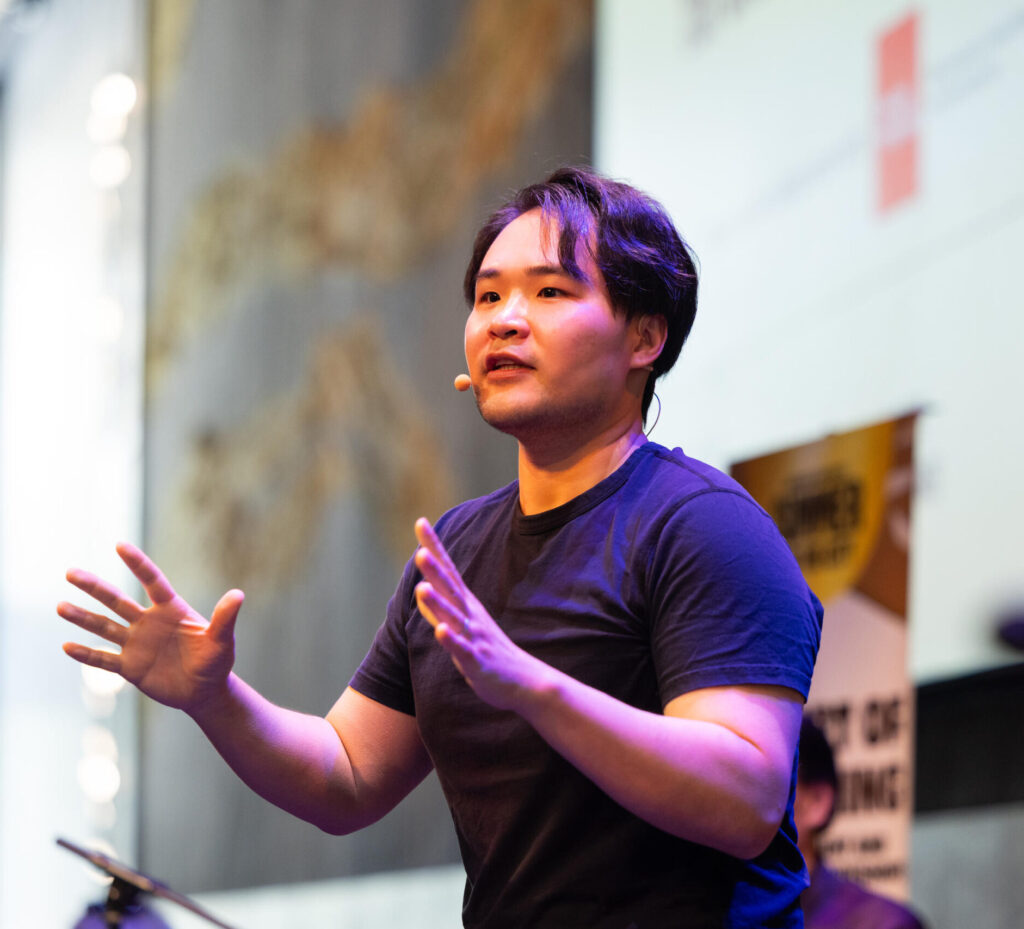
Raymond Lee
Tai Chi Ray
Raymond Lee (Tai Chi Ray) is a Tai Chi teacher, martial arts practitioner, and writer who has been teaching and sharing Tai Chi in New York since 2017. He began practicing martial arts at the age of seven and grew up in a family with more than five generations of involvement in Traditional Chinese Medicine. Ray explores Tai Chi through structure, coordination, awareness, natural movement, and the integration of body and mind. His work seeks not only to preserve traditional principles, but to make them understandable and meaningful in contemporary life.