JOURNAL · TAI CHI PHILOSOPHY & LIFE
Tai Chi movement is often described as flowing like water. But “move like water” should not remain only a beautiful metaphor. Water gives us a practical model for movement: it continues without unnecessary interruption, adapts without losing itself, yields without becoming powerless, and follows gravity rather than constantly fighting against it.
IN THIS ARTICLE
More Than Looking Fluid
Why Water Appears So Naturally in Tai Chi
1. Water Teaches Continuity
2. Water Teaches Adaptability
3. Soft Does Not Mean Weak
4. Water Does Not Fight Gravity
5. Flow Requires the Whole Body
From Swimming in Water to Moving Like Water
How Can You Practice Moving Like Water?
Do Not Copy Water—Learn From It
More Than Looking Fluid
People often describe good Tai Chi as “flowing like water.”
From the outside, the meaning seems obvious.
The movements are slow. They connect continuously. The arms travel in circles. The body appears relaxed and smooth.
But merely looking fluid is not the same as moving like water.
A person can make beautifully smooth arm movements while the shoulders remain tense, the weight is poorly organized, and the arms are disconnected from the rest of the body.
That may look flowing.
But the deeper qualities of water are missing.
When I think about water in Tai Chi, I am less interested in copying its appearance than in understanding how it behaves.
Water does not move beautifully because it is trying to look beautiful.
Its beauty comes from the way it responds to conditions.
To move like water is not to imitate the appearance of water. It is to learn from the way water responds.
Why Water Appears So Naturally in Tai Chi
Water has followed my own Tai Chi practice for many years.
In my earlier article, Why I Call Tai Chi “Swimming in the Air”, I wrote about the summer afternoon when I began experimenting with Cloud Hands and circling movements inside a swimming pool.
The resistance of the water made relationships inside my body easier to feel.
It taught me something very directly: movement is not simply about sending one limb from one position to another.
The entire body has to negotiate the environment.
Years later, when I encountered older Tai Chi descriptions that also used water to describe the development of movement, I felt an immediate resonance.
In one description attributed to Grandmaster Hao Weizhen, an earlier stage of practice feels as though the body is moving through water and encountering resistance. With refinement, movement develops a sense of buoyancy and greater freedom. At a higher level, the body becomes increasingly light and effortless while awareness remains precise.
What interests me is not whether we should reproduce these images literally.
It is the direction they point toward.
The better the movement becomes, the less it depends on unnecessary force.
It becomes more continuous, more responsive, and less obstructed from within.
1. Water Teaches Continuity
Watch water moving through a stream.
It does not normally travel as a sequence of isolated pieces.
One part leads into another.
The shape changes continuously, but the movement remains connected.
This is an important quality in Tai Chi.
A beginner often experiences a Tai Chi form as separate instructions:
Move the hand.
Turn the waist.
Shift the weight.
Step.
Now move the other hand.
This is a natural stage of learning. We have to separate things before we can understand them.
But eventually, those pieces have to reconnect.
The weight shift begins the turn.
The turn changes the relationship of the torso.
The shoulders and arms respond.
One movement creates the conditions for the next.
Instead of:
stop → reposition → start again,
we gradually discover:
change → transform → continue.
In Tai Chi, flow does not mean that nothing changes. It means that change does not unnecessarily break the movement.
2. Water Teaches Adaptability
Water has no need to insist on one permanent shape.
Pour it into a cup and it takes the shape of the cup.
Let it travel over uneven ground and it changes direction.
Place an obstacle in its path and it may divide, circle around it, collect behind it, or find another route.
Yet through all of these changes, it remains water.
This quality is deeply relevant to Tai Chi.
When we first learn a movement, we need a recognizable structure. The hand goes somewhere. The feet have a relationship. The weight shifts in a particular direction.
But if we become attached only to the external shape, the movement can become rigid.
Real conditions are never perfectly identical.
The floor changes.
Our balance changes.
Another person changes.
Distance changes.
Direction changes.
Even our own body feels different from one day to the next.
A useful Tai Chi principle therefore cannot depend on everything outside us remaining exactly the same.
We have to preserve the principle while allowing the shape to adapt.
This is one reason martial intention is useful even for people who have no interest in fighting.
If I understand what a movement is trying to accomplish, I can adapt its outward shape when conditions change.
If I know only the choreography, I may become lost as soon as the choreography no longer fits the situation.
3. Soft Does Not Mean Weak
Water also helps us understand one of the most frequently misunderstood qualities of Tai Chi: softness.
Tai Chi is often described as soft.
Unfortunately, “soft” can easily be interpreted as limp, passive, or weak.
Water shows us something different.
Water yields.
But yielding does not mean disappearing.
A river changes around rocks while continuing downstream.
A wave gives way and returns.
Water can feel gentle against the skin, yet the same water moving with sufficient mass and momentum can exert tremendous force.
The lesson for Tai Chi is not that we should become physically loose and collapse.
It is that unnecessary rigidity is not the same as strength.
This connects directly with the Tai Chi idea of Song (鬆).
Song is often translated as relaxation, but I use the idea more specifically: relaxing unnecessary muscular tension while preserving structure and readiness.
Think again about water.
It does not need to become rigid in order to remain powerful.
Its strength comes partly from continuity, mass, direction, and its ability to keep responding.
Softness in Tai Chi is not the absence of strength. It is the absence of unnecessary resistance inside ourselves.
4. Water Does Not Fight Gravity
There is another reason water is such an important teacher for me.
Water follows gravity.
It naturally moves downward unless something redirects it.
It does not need to manufacture an argument with gravity first.
Tai Chi movement can teach us a similar relationship.
Many people begin movement by contracting muscles and deliberately pushing a body part into motion.
Tai Chi often asks us to investigate another possibility.
Can a change in weight begin the movement?
Can sinking create the conditions for rising?
Can shifting the center initiate movement through the rest of the body?
In my teaching, I often describe this as borrowing momentum from gravity.
When we sink or shift, the feet interact with the ground. The body receives reaction force through its structure. The legs, waist, spine, shoulders, and arms can then participate in the movement.
This does not mean becoming passive and simply falling.
We are still organized.
But instead of treating gravity only as something to overcome, we learn to cooperate with it.
That is a very different physical attitude.
And once again, water gives us the image.
5. Flow Requires the Whole Body
A final misunderstanding about “flow” is that it belongs mainly to the hands.
Tai Chi hands often move in large, beautiful circles, so our attention naturally goes there.
But if only the arms are flowing, the body is not yet moving like water.
Whole-body movement means that different parts of the body participate in one changing relationship.
Take Tai Chi circling.
From the outside, the hands may describe circles.
Internally, the wrists, shoulders, shoulder blades, waist, hips, ankles, weight shifts, and central axis are all contributing to the movement.
This is closer to what I experienced when I first experimented in the swimming pool.
The water would not allow me to believe that one isolated limb was the whole movement.
The body had to organize itself as a whole.
That lesson later became central to what I call “Swimming in the Air.”
From Swimming in Water to Moving Like Water
There is an important difference between these two ideas.
“Swimming in the Air” describes how I use the experience of moving through water to sharpen sensitivity during Tai Chi practice.
“Moving like water” asks a broader question:
What qualities of water can guide the way we organize movement?
The first is primarily a training image.
The second is a principle.
Swimming taught me to feel resistance, alignment, breathing, and coordination.
Water itself taught me something larger:
- continue instead of unnecessarily stopping,
- adapt instead of becoming rigid,
- yield without collapsing,
- follow gravity rather than fighting it, and
- remain connected while changing shape.
These qualities help explain why water appears again and again when I think about Tai Chi.
How Can You Practice Moving Like Water?
Do not begin by trying to make your Tai Chi look more fluid.
That can easily turn “flow” into another performance.
Instead, choose one simple movement and investigate the qualities behind the appearance.
Ask yourself:
- Where am I unnecessarily stopping?
Can one part of the movement naturally create the next? - Where am I rigid?
Can I preserve structure while allowing adjustment? - Where am I forcing?
Can shifting weight or gravity initiate more of the movement? - What happens when conditions change?
Can I preserve the principle without insisting on exactly the same shape? - Is my whole body involved?
Or am I merely making flowing shapes with my hands?
These questions are more useful than telling yourself:
“Be more flowing.”
Flow is not something you paste onto a movement from the outside.
It emerges when unnecessary interruption, rigidity, and isolated effort begin to disappear.
Do Not Copy Water—Learn From It
To say that Tai Chi should “move like water” can easily become a cliché.
Water is peaceful.
Water flows.
Therefore, Tai Chi should look peaceful and flowing.
That interpretation is not wrong.
It is simply too shallow.
Water is valuable because it teaches us how movement can remain continuous while changing, how softness can coexist with strength, how adaptation can replace unnecessary resistance, and how gravity can become something we cooperate with rather than constantly oppose.
The goal is therefore not to make ourselves look like water.
It is to learn something from how water behaves.
When that lesson begins to enter the body, “flow” stops being an aesthetic quality.
It becomes a way of organizing movement.
Do not try to look like water. Learn how water moves, changes, yields, and continues.
FROM TAI CHI RAY’S NOTES
Tai Chi Ray’s Notes No. 2 — Swimming in the Air
The idea of learning from water first appeared in Tai Chi Ray’s Notes No. 2, where I explored “Swimming in the Air” through spine position, whole-body coordination, breathing, and my own experience of practicing Tai Chi movements in water.
CONTINUE READING
What Does Song (鬆) Really Mean in Tai Chi?
Water can yield without becoming powerless. Tai Chi asks something similar of the body. Continue with Song (鬆)—why relaxation in Tai Chi does not mean becoming limp, and how softness can coexist with structure, balance, readiness, and the ability to respond.
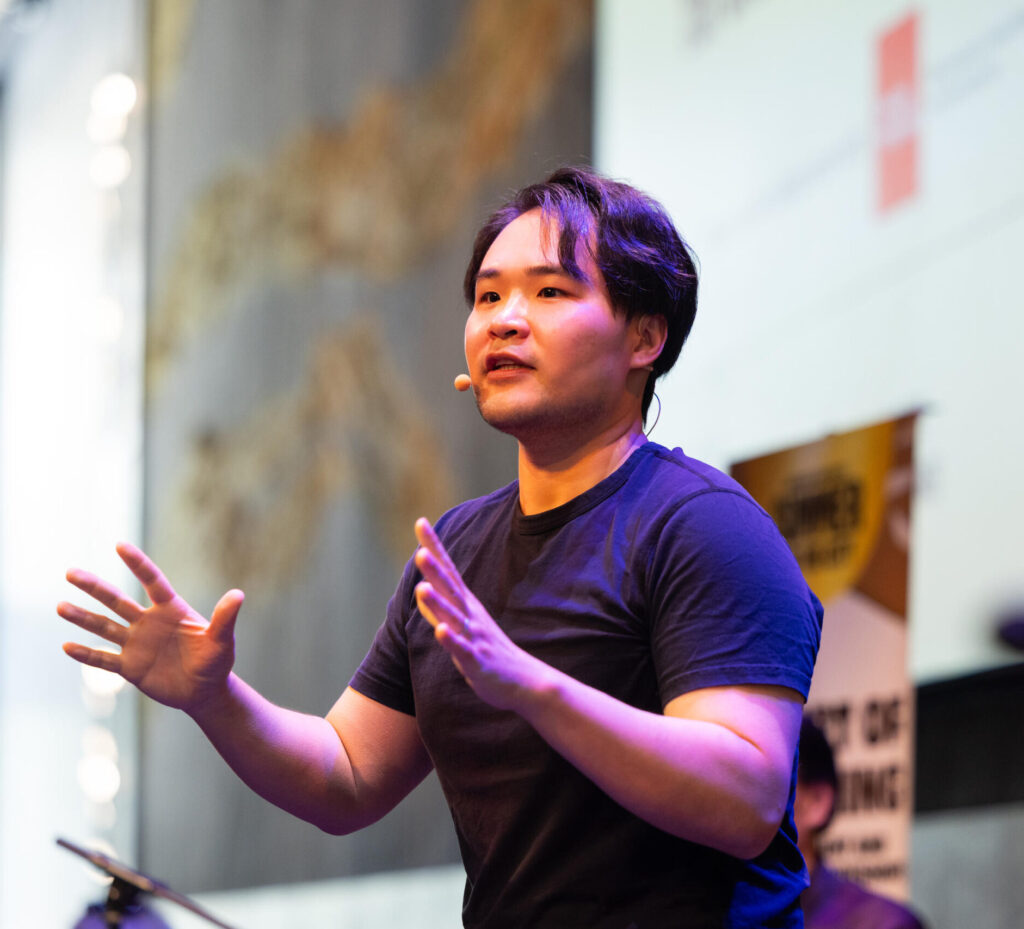
Raymond Lee
Tai Chi Ray
Raymond Lee (Tai Chi Ray) is a Tai Chi teacher, martial arts practitioner, and writer who has been teaching and sharing Tai Chi in New York since 2017. He began practicing martial arts at the age of seven and grew up in a family with more than five generations of involvement in Traditional Chinese Medicine. Ray explores Tai Chi through structure, coordination, awareness, natural movement, and the integration of body and mind. His work seeks not only to preserve traditional principles, but to make them understandable and meaningful in contemporary life.