TAI CHI RAY’S NOTES · NO. 2
What can water teach us about Tai Chi? Through three “gold bars”—the spine, whole-body coordination, and breathing—I explore how we can learn to move with greater awareness, connection, and ease, as if swimming through the air.
IN THIS NOTE
Introduction — The Three Gold Bars
I. The Spine — Learning from Water
II. Body Coordination — Bringing Water into the Air
III. Breathing — Creating Space Within
Conclusion — Swimming in the Air
Introduction — The Three Gold Bars
I remember that whenever my grandfather wanted to emphasize a secret method of practicing Tai Chi, he would look in my eyes and say in a very serious tone, “In my time, you had to offer me a gold bar to exchange for it.”
As a grade schooler, I only saw gold bars in the movies and could imagine how valuable they must be; otherwise, it would not make any sense why so many people would kill or die for them.
But now, as a financial professional in practice and a regular guest speaker at the School of Finance of my alma mater, I can share with you that the gold bars my grandfather referred to were weighed around 1 kilogram (about 35.15 troy ounces) each.
In the 1970s and 1980s, three gold bars would have been worth more than enough to buy a very decent—and often quite large—apartment in New York City.
I would borrow my grandfather’s serious tone to tell you that what I am going to share next would be worth three gold bars by my grandfather’s standard. If you practice diligently by following the principles of “Swimming in the Air”, you are developing a very decent spiritual space, like the concept of Qigong, for your body-mind to dwell in.
This inner space will nurture your overall well-being day and night. Let’s get started!
Knowing how to swim benefits your Tai Chi practice. If my memory serves me correctly, most of you who have practiced Tai Chi with me are swimmers. Swimming and practicing Tai Chi have a lot in common, such as a love of the virtues of water, inner peace (swimming can be seen as a solitary activity), and so on.
In this note, I am going to compare “swimming in the water” with “swimming in the air” through three points. The first point is the position of our spine; the second is body coordination or the kinetic chain; and the last is breathing. Each is worth one gold bar.
Part One: The Spine — Learning from Water
How can a vertical human body remain stable while still moving freely?
The Puzzle of the Vertical Spine
As we all know, the human spine is vertical compared with those horizontal spines of cats, dogs, tigers, wolves, etc. The vertical spine makes it almost impossible to perform movements, such as pouncing like a tiger, high-speed sprinting (40 to 50 mph) like a mountain lion, explosive leaping like an antelope, tugging like a wolf, and so on.
It is because our vertical spine acts as a weight-bearing pillar, unlike the horizontal, suspension-bridge design of other quadrupeds’ spines.
Our human ancestors, in their survival mode in nature, must have admired the power, agility, and grace of our first group of martial arts teachers – the quadruped. I suspect the foremost puzzle for our ancestor warrior-scholar to solve is how to transfer the reaction force from the ground through our spine to our limbs as efficiently as our teachers, the quadruped.
As my reader, I am so happy that you can read to this line. Now I recommend you pause to stand up and put yourself in our ancestor warrior-scholar’s feet (I am not sure if they had shoes by then) to try to solve this puzzle before you read on.
I presented this puzzle to you just like my grandfather had presented it to the 7-year-old me. The younger me had tried different ways to solve this puzzle; for example, I tried sprinting in bear-crawl mode or bouncing by imitating a frog or a rabbit (yes, I convinced my grandma to buy them as my pets). Also, I got a hold of cats and dogs as my pets and several tickets to the zoo in the name of puzzle-solving.
This puzzle, along with other puzzles and riddles, has accompanied me for many years because my grandfather never gave me any verbal answers to all his riddles and puzzles.
When I asked for an answer, he said, “Your body will answer you at the right moment.”
In our 3-dimensional physical existence, time is a one-way forward illusion. We cannot travel back to witness how our ancestor warrior-scholar solved this puzzle, or whether there was a puzzle in the first place.
But I believe that inspiration can go beyond our 3-dimensional limit to sneak a peek into the realm of 4 dimensions, where time can be listed as frame(s) after frame(s) of a movie timeline(s) that one can examine all at once.
The Afternoon I Became a Dog
The inspiration struck me when my cousins caught me off guard, grabbed my arms and legs, and threw me into the water. Choking on a few mouthfuls of water and feeling the urge to cough it out of my lungs cleared all my memory and knowledge of breaststroke, butterfly stroke, or freestyle swimming.
The instinct of survival took over, forcing me to doggy-paddle to stay afloat and stick my head out of the water to cough. My body tilted against the waterline with my head out, and my limbs and spine coordinated the paddling to balance me as I coughed, my eyes closed.
Time started to slow down. Then the inspiration struck me in a Chinese sentence, and I translated it in English here – “Wait a second! Am I doing what a dog is doing?”
For the rest of the summer afternoon, I ignored all the play invitations from my cousins and indulged myself in feeling my entire body coordination by paddling like a happy doggy.
Later that afternoon, I even experimented with Tai Chi cloud hand and circling by stepping on the bottom of the pool with my head out or immersing myself in the middle of the water. In the end, I even won an ice cream from my cousins, who apologized because they thought I was mad at them all afternoon.
“Your body will answer you at the right moment.”
In retrospect, that was one of the most beautiful summer afternoons in my life. Not only did I meet the inspiration, but I also realized unconsciously something very core to our human nature and Tai Chi practice.
The essence of health cultivation is simple: our nature loves free, unrestrained, and coordinated movement, in which our innate abilities can arise. Tai Chi practice does not have to be complicated.
Each morning, in the fresh air, one simply allows the body to move slowly and naturally by feeling the resistance of the air, with the joints neither fully bent nor fully straight, and with the mind and heart embracing awareness and restfulness simultaneously, open to the vastness of the sky.
At the same time, observe the circulation of Qi (energy flow) and blood within the body, and sense the subtle interaction between oneself and the surrounding environment, much like swimming or being a fish in the pond.
Through this practice, both body and mind become relaxed and comfortable. Without artificial constraints, one gradually develops a deeper awareness of oneself and nature. Over time, innate abilities awaken, inner insight emerges, and the foundations of martial skill are established naturally, without conscious effort.
What Water Taught Me About Tai Chi
15 years after the inspiration, I encountered a summary by Grandmaster Weizhen Hao (1849–1920), who was one of the most influential masters of Wu (Hao)-style Tai Chi Chuan. He wrote, and I translated it into English as follows:
“At first, practice feels like moving through water—every action meets resistance, and the feet remain firmly rooted.
With further refinement, the body gains buoyancy, as if floating in water, able to move naturally and without obstruction.
At the highest level, the body becomes light and effortless, as though walking upon water itself. One maintains the utmost awareness, as if standing at the edge of a precipice or treading on thin ice. The mind is collected, the spirit inwardly focused, and no movement is careless. This is the attainment of true mastery in Tai Chi.”
I love reading because, through books, I can transcend time and space and commune with great minds, discovering echoes of my own thoughts in theirs. For the next two parts of the note, I am going to share the next two points—body coordination, or the kinetic chain, and breathing.
I don’t think I reached the highest level described by Grandmaster Hao, but in a few very quiet moments of my practice, I had a taste of it, and it involves smooth, effortless coordination of body movements, breathing, and mindfulness. It was like a conscious daydreaming of Tai Chi practice.
Part Two: Body Coordination — Bringing Water into the Air
How can the body move as one rather than as a collection of separate parts?
Water as a Teacher
In this part, I will further discuss the coordination of the body, or the kinetic chain, in Tai Chi movements, which is worth another bar of gold. Since water has already been our good but mysterious teacher, let us continue hearing the teaching of water.
Water is roughly 800 times denser than air. If your body movement is not coordinated, water gives you immediate feedback by pushing you backward or dragging you down, draining your energy very quickly. In this regard, water is really a good but strict teacher with zero tolerance for errors.
In comparison, you would not feel the same feedback when moving through the air with improper body alignment and faulty movement patterns. Instead, poor movement patterns often develop gradually through repetitive habits, compensation patterns caused by past injuries, or lack of flexibility, which can show up in subtle ways before pain or injury catches up with you.
In my understanding, injuries rarely happen “out of nowhere”. Usually, they result from repeated stress on the body structure caused by faulty or compensatory movement patterns. Therefore, I have been emphasizing the importance of correct body structure in every session.
As you read this sentence, please check your posture. For example, I tightened up my shoulder when I was typing this paragraph. Yes, articulating my thoughts by using English really tensed me up.
Finding the Long Axis
How to swim efficiently? Proper spine alignment to minimize drag is the answer. The angle of your body in the water creates drag, and you must burn energy to overcome it. The less horizontal your bodyline is, the more resistance you will encounter as you have a larger cross-section with water. An aligned body reduces resistance; a bent body increases it.
The goal is to be as narrow and horizontal on the water as possible so that all the energy can be maximized into moving forward.
Taking freestyle swimming as an example, freestyle is a long-axis stroke, which your body rotates on its long axis – the imaginary line from the top of your head straight through your spine.
This long axis is VERY IMPORTANT in our Tai Chi practice as well. We cultivate a sense of the long axis through Wuji standing meditation, cloud hand practice, and the triangle steps. During my session, I used “the hinge of your body”, “center line”, and “middle line” interchangeably with “the long axis”.
Good swimmers know that good spinal alignment starts with your head, and your chest and hips play important roles; the same logic applies to Tai Chi body structure, but in the vertical direction.
Everyone is different, so you have to experiment to find out the ideal position for yourself. What feels normal or easier is not always the best or the most efficient.
Also, one may perform visually graceful Tai Chi movements, but this does not mean that one’s structure is strong or even correct. After you can do elegant Tai Chi movements, you need to receive external forces from different angles to test your structure and counter movements. We have Tai Chi push-hand practice for this test.
In summary, getting feedback from your Tai Chi instructor, a knowledgeable Tai Chi practitioner during Tai Chi push-hand practice, or from external forces on a train helps you develop the right body structure and timely reactions to counter movements for balance, bypassing thinking.
As I mentioned above, it is hard to know if you move your body efficiently through the air without encountering counterforces, such as a sudden push, pull, turn, or twist, or a loss of balance on uneven ground.
So, how to bring the water’s training quality into the air? It is another million-dollar question. In the last note, I mentioned that heuristic learning is a tradition passed down by my grandfather.
Now, please pause your reading here and try to find your answer to this question by yourself.
How Do We Bring Water’s Training Quality into the Air?
Just like Yin and Yang, there are always two approaches to addressing any questions: changing things outside yourself, such as establishing a gale-generation facility or creating a zero-gravity environment, or changing yourself.
As a follower of Tao (the way or the path), I always choose to change myself by honing my senses to feel the air’s resistance through the proven methods. The training methods had already been presented to you as part of the routine in every session we had together. I will summarize them below for your self-study.
Wuji (無極) and the Meaning of Sōng (鬆)
First and foremost is the Wuji standing meditation. “Wuji” (無極) can be translated into “infinite, limitless, or measureless ”. More importantly, “Wuji” is beyond the human sense of measurement, attribution, or comparison. If you have only three minutes in your life to learn Tai Chi, I will share the Wuji standing meditation with you. By merely tasting a moment of opening hands of thought, you will benefit from it for the rest of your life.
Thoughts create emotions, and emotions drive your Qi energy. For example, when you are grieving excessively, Qi energy becomes dissipated and stagnant, and when the smooth flow of Qi is disturbed, the internal heat of your body becomes trapped and accumulates, further consuming Qi and leading to breathing disruptions.
You may see one who is overwhelmed by sorrow stamping one’s chest and pounding one’s feet. One is not punishing oneself but following an innate human survival instinct to gather and circulate Qi again so that one can breathe again. Besides grief, Traditional Chinese Medicine has summarized another six interactions between Qi and emotions.
Therefore, when you let go of comparing and attributing, your body will regain control of the Qi flow, allowing Qi to go where it is most needed, thereby preventing illness before it develops and restoring balance before disease takes hold.
In Traditional Chinese Medicine, the highest form of healing is not treating disease after it appears but recognizing imbalance early and restoring harmony before illness manifests.
“How do we bring water’s training quality into the air?”
When you have the right mindset during the Wuji standing meditation, your body will shift from the sympathetic nervous system (“fight or fight”) to the parasympathetic nervous system (“rest, digest, and restore”).
By doing so, you give yourself permission to deliberately engage your deeper muscle layers by expanding your bone structure and relaxing your superficial muscle layers on the bone structure. You will use the minimum number of muscles to hold the stance.
This is the first step to feel about “sōng” (鬆), which is relaxed within a proper Tai Chi bone structure. This feeling of Tai Chi relaxation is one of the principles governing all your movements. Most of you shared with me the shaky, wobbly feeling that comes from loosening the grip of your glutes and thigh muscles; some of you even beautifully put it as “just like standing in the swimming pool.”
In our modern daily life, most people habitually overuse the superficial layers of muscles and underuse or poorly coordinate the deeper layers. Therefore, it must be practiced deliberately to reconnect our brains to the use of the deeper layers of our muscles through slower, more mindful movements, just as an infant explores how to crawl or walk.
However, due to the slow movements, Tai Chi has been deeply misunderstood as being for seniors only. People of any age should know how to master the deeper layers of muscles.
Let Gravity Begin the Movement
By nurturing the body-mind sensation of “sōng” (鬆), at one point, you will be very confused since you cannot feel your arms or legs anymore. So how can you move again? How does water flow? Through gravity! In Tai Chi, we borrow the momentum from gravity through sinking and shifting.
For example, during our session, we sank or shifted our gravity points to create the first momentum to move. As you sink and shift, your body will experience the reaction force from the ground. This reaction force will travel within a proper Tai Chi body structure through your legs to your waist, through your spine, shoulder blades, shoulder joints, and manifest in your fingers.
The body’s coordination occurs internally via the fascia and interstitium and is initiated by breathing, which is named “One Qi,” loosely translated as “accumulated internal pressure.” In the next note, I will continue sharing the body coordination and the breathing.
Part Three: Breathing — Creating Space Within
How can breathing create space for movement rather than interfere with it?
Jìng (靜): A Benchmark for the Mind
In this part, I am going to share about breathing – the third bar of gold. Just like water, breathing is another profound teacher of Tao (the way or the path), sharing wisdom with you or providing rescue to you around 20,000 times per day.
We just must learn to tune in to the wisdom or rescue channel, which will benefit our overall well-being and protect the people around us, especially our loved ones. How to tune in? The answer is very simple – by forming a habit of doing Wuji standing meditation.
From the last part, you already knew that doing Wuji standing meditation can help you develop a “sōng” (鬆) (relaxed but structured) body structure and awareness of muscle imbalance. By the same token, doing Wuji standing meditation can help you develop a state of “jìng” (靜) (calmness) mental structure where Qi is circulating naturally, and awareness of how your thoughts trigger emotions, and how emotions affect your calmness.
Therefore, practicing Wuji standing meditation helps establish benchmarks for your body and mental structure so you can catch yourself before you lose your balance, bodily or mentally.
Catch Yourself Before You Lose Balance
Let’s take anger as an example. From the perspective of Modern Medicine, when we become angry, our body activates the sympathetic nervous system, so our breathing becomes faster, our muscles tighten, our blood pressure rises, and blood is directed upward toward the head.
This is why people may experience headaches, dizziness, a flushed face, or a red complexion when they are angry. At the same time, the body diverts resources from digestion to a “fight-or-flight” state.
As a result, digestion slows down, which can lead to bloating, indigestion, or diarrhea. And what did Traditional Chinese Medicine say from the Qi perspective?
In Traditional Chinese Medicine, excessive anger causes Qi to rise upward. Anger is related to the Liver, which stores the blood. Since Qi leads the movement of blood, when Liver Qi rises excessively, it can drive blood upward, potentially leading to symptoms such as headaches, facial flushing, nosebleeds, or, in severe cases, vomiting blood.
That is why, when I am about to become livid, I would hear a long buzzing sound in my head, the last warning that my reason circuit is going to break.
If Liver energy becomes excessively forceful and disrupts the Spleen, the Spleen’s digestive function weakens, resulting in poor digestion, bloating, and diarrhea. If you still remember how the Five Animal Play connects to the Five Element Theory, you will recognize that Deer Play corresponds to Liver Energy, which corresponds to the Wood element, the season Spring, and anger.
When the Wood element becomes excessive, it suppresses the Earth element, which relates to Spleen energy (digestion), the late Summer season, overthinking, and the Bear Play. And what is the immediate remedy to anger?
The immediate remedy for anger is to catch yourself before you fall into the vicious cycle of the emotional whirlpool.
The ability to catch yourself before a mental or physical imbalance arises from the Wuji Standing meditation practice. Once you become aware of the moment of imbalance, you can disconnect from the things, thoughts, or people that trigger or exacerbate your anger.
The last and most important step is to find a space (physical or mental) so that you can vocalize “xū” (噓) (similar to the pronunciation “she”) sound (with or without making sound) and let the sound vibrate in your body to channel the Qi energy away from your head. If you happen to be a musician, you may have a feeling that “xū” sound has a downward energy tendency.
Some of you are familiar with this sound since we always vocalize it during our Spring sessions. Yes, “xū” sounds correspond to Wood element, Spring, Liver, etc. For those who are new to this system, the “xū” (嘘) sound belongs to the Six Healing Sounds (“Liù zì jué 六字訣” ), which is an ancient Daoist breathing exercise. Each of the six sounds is associated with a different organ system in Traditional Chinese Medicine.
When combined with slow breathing and gentle movement, the practice helps relax the body, channel Qi, calm the mind, and promote overall balance and well-being. Interestingly, in English, we use “shush” to hush someone, especially when we get agitated or angry. These two pronunciations are close to the “xū” sound.
What Does It Mean to Breathe Naturally?
For those who have been practicing Tai Chi with me long enough, you will notice that I have been emphasizing Tai Chi Circling, which includes Cloud Hand practice, in addition to Wuji standing meditation. Why?
It is because the first step of Tai Chi practice is to strengthen your Lung energy.
In Tai Chi and Traditional Chinese Medicine, there is a saying, which I paraphrased as “strong lung (energy) helps keep illness away (肺強百病消).” The word-to-word translation of this saying is even more absolute – “strong Lung (energy) eliminates a hundred diseases.”
This shows the importance of Lung energy health. One thing I need to point out: in Traditional Chinese Medicine, Lung energy or Liver energy does not refer to our lungs or liver organs.
“You should view the Five Element Theory, which is one of the foundations of Traditional Chinese Medicine, from the energy level,” said my grandfather, who had practiced Traditional Chinese Medicine for more than five decades.
Also, in traditional Chinese culture, when we describe a person as super strong, we call them a “strong lungs person” rather than “muscular or ripped.” Being truly healthy in the inner organs is strong. Therefore, at the beginning of your Tai Chi practice, we focus on nurturing the health of inner organs through breathing practice via Wuji standing meditation and Tai Chi Circling.
Interestingly, all the spiritual practices rooted in different cultures I have experienced have emphasized breathing and regarded it as a path to enlightenment.
Most of you asked me the same question – “how to breathe in the Tai Chi movements?” I always give you the same answer – “naturally”. But how to breathe naturally? You can pause here to contemplate for a while and check your reading posture. I will review the answer later. I guarantee you that all of us knew the answer. You may have forgotten it at one point in life.
Natural breathing is breathing like an infant, using belly breathing or diaphragmatic breathing. We were all infants before, so we all experienced belly breathing. If you don’t have an infant at hand to observe, you can search “infant belly breathing” on YouTube or take a look at how your dog or cat breathes when they are relaxing. When they breathe in, their bellies expand; when they breathe out, their bellies contract.
When we use diaphragmatic breathing, our internal organs move and rub against each other, pushed or pulled by the diaphragm, which is a form of self-massage. For example, if you make diaphragmatic breathing a habit, your heart and kidneys will travel up and down around 20,000 times per day. I will compose another note specifically for belly breathing in the future.
The essence of Wuji standing meditation and Tai Chi circling practice is to create space within you. Some of you shared with me that in Western culture, standing (or walking) in a positive posture with your knees straightened, chest puffed out, and belly sucked in can appear strong, formidable, and even authoritative to others. It appears true.
However, from a Tai Chi point of view, straightening your knees limits your ability to move, puffing out your chest elevates your balance point above your waist, making you less grounded, and sucking in your belly makes your breathing shallower by restricting the expansion of your lungs.
You may feel tired easily by standing in the positive posture because you create an energy field outside of you by consuming your own energy and activate your sympathetic nervous system to “fight or flight” all the time, which cannot make you feel restful. It is like pushing the gas pedal hard in Neutral (N) in a Lamborghini. It sounds powerful but goes nowhere and wastes fuel.
Relaxed, Yet Ready
Different cultures have their own animal images of strength and power, such as the bear, tiger, lion, and wolf. If you observe their physical and mental structures, you will be surprised to find that they are always relaxed yet ready. For example, there is an old Chinese saying: “The tiger moves as if it were ill. (虎行似病).”
This does not mean the tiger is actually sick. Rather, it describes a tiger that moves slowly, quietly, and without unnecessary tension. It appears relaxed and effortless, yet beneath that calm exterior lies tremendous strength and explosive power, which will be used for the first but final attack. Tai Chi is all about Yin and Yang, which you can apply in many contexts.
For example, if you see a politician who is trying very hard to appear strong and authoritative outside, you should question his or her inner strength; maybe he or she is insecure. Just like every Tai Chi movement, true strength comes from the inside out.
“True strength comes from the inside out.”
By standing in Wuji meditation, you nurture self-awareness and give yourself permission to relax, be grounded, and expand your belly. All of us know that if you don’t use your diaphragm, you will lose it, and the space of your lungs and belly will shrink. Coupled with a fast-paced lifestyle and high work pressure, several younger participants came to me because they were diagnosed with hyperventilation and could not breathe into their belly. The remedy is Wuji standing meditation.
Tai Chi Circling: Kneading the Body from Within
Doing Tai Chi cycling with natural breathing is like kneading dough. As we all know, when you knead the dough wholeheartedly for about 10 minutes. This stretches and folds the proteins to develop a gluten network, making the dough stretchy and chewy. In this analogy, kneading is the Tai Chi cycling movements, the dough is your body structure, and the gluten network is your fascia.
Fascia is a connective tissue network that surrounds, supports, and connects muscles, bones, nerves, blood vessels, and organs. Or you can imagine fascia as a three-dimensional web that wraps and connects everything in your body. Rather than isolated movements, Tai Chi emphasizes whole-body connectedness, as I noted in my last note.
All Tai Chi movements are generated from inside, just like how the jellyfish moves. Generating from inside means activating your deeper muscle layers, passing the inner momentum and energy flow to your limbs through the center tendon of your diaphragm via belly breathing, expanding and contracting your fascia, and from the heart to the body.
For example, when you are doing Tai Chi non-sync circling, your arms are drawing the Tai Chi Yin and Yang diagram. At the starting point, your right arm is at the top while your left arm is at the bottom, which stretches your fascia structure up and down. In the middle of the movement, your right arm is in the top-right corner, and your left arm is in the bottom-left corner, which stretches your fascia diagonally. The entire Tai Chi non-sync circling is just kneading your body structure through the help of gravity, joint rotation, and mindful practice.
Conclusion: Swimming in the Air
In summary, Tai Chi is about internal movements and awareness because we have focused too much on things outside ourselves. In this AI era, it is about time we brought our attention back to our inner well-being.
Just like your kids and pets, your heart, brain, eyes, tongue, fascia, deeper muscle layers, inner organs, the bottom of your feet, your spine, hips, pelvic floor, and other body-mind parts love your attention!
In this second Tai Chi Ray’s note, I elaborated the key Tai Chi concept “swimming in the air” through three points. The first point is the position of our spine; the second is body coordination or the kinetic chain; and the last is breathing.
Each is worth one gold bar. Although I have composed more than 5,000 words for this note, I have written far more in the draft and have decided to set it aside for special topics in the future. The second note has successfully laid a conceptual foundation for your Tai Chi practice.
Mission completed!
Till next time!
CONTINUE READING
TAI CHI RAY’S NOTES · NO. 3
First Step: Don’t Chase After Movements
If Tai Chi is more than the outward movements we see, how should we actually learn it? In the next note, I explore why learning more movements does not necessarily mean learning more Tai Chi—and why going deeper into even a single movement may reveal principles that extend throughout the entire art. Read Note No. 3 →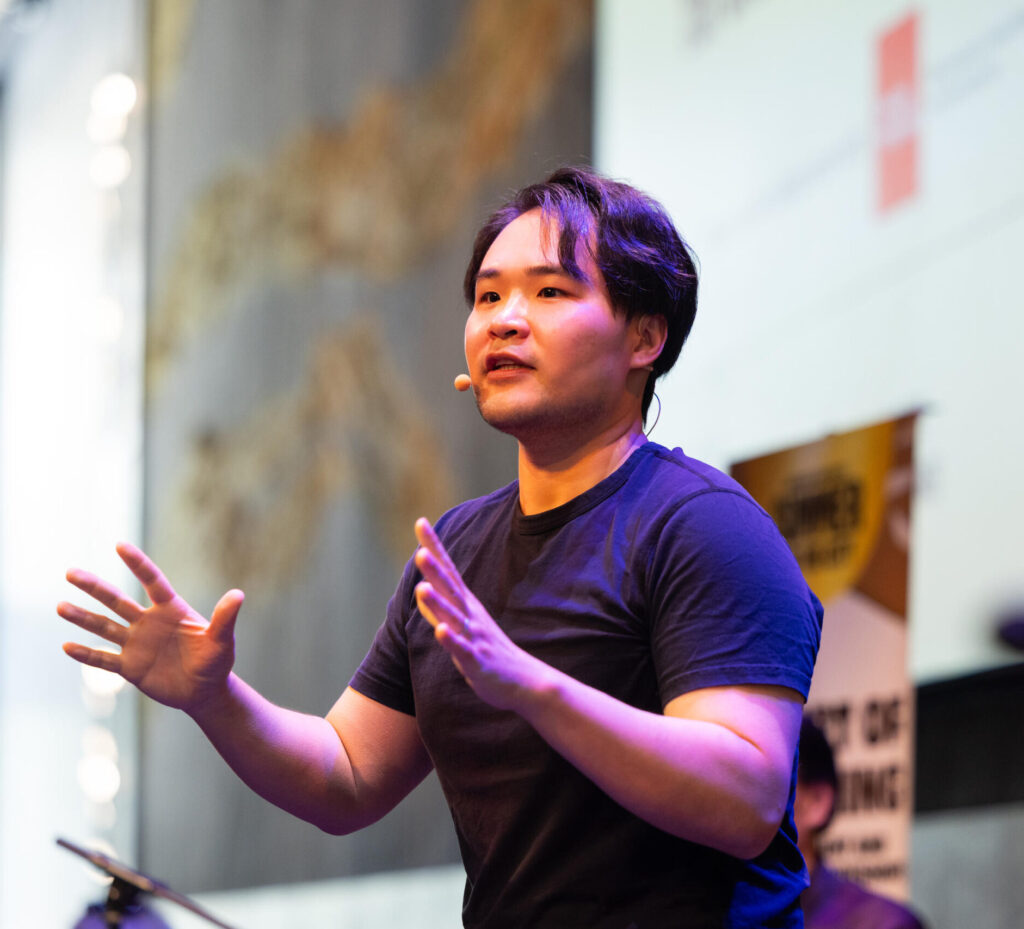
Raymond Lee
Tai Chi Ray
Raymond Lee (Tai Chi Ray) is a Tai Chi teacher, martial arts practitioner, and writer who has been teaching and sharing Tai Chi in New York since 2017. He began practicing martial arts at the age of seven and grew up in a family with more than five generations of involvement in Traditional Chinese Medicine. Ray explores Tai Chi through structure, coordination, awareness, natural movement, and the integration of body and mind. His work seeks not only to preserve traditional principles, but to make them understandable and meaningful in contemporary life.