JOURNAL · TAI CHI PRINCIPLES & MARTIAL ARTS
Yi (意) is often translated as “intention,” but in Tai Chi it means more than simply thinking about a movement. Yi gives a movement direction and purpose. It connects what we intend to do with how the body organizes itself to do it.
IN THIS ARTICLE
What Is Yi (意) in Tai Chi?
Eyes Can See the Movement—but Not the Yi
The Movement Is the Shape; Yi Gives It Purpose
Understanding Yi Through Cloud Hands
Yi Organizes the Whole Body
Why Martial Intention Still Matters
How Can You Begin Practicing Yi?
From Copying a Movement to Understanding It
What Is Yi (意) in Tai Chi?
Yi (意) is one of those Chinese words that becomes smaller when we try to fit it neatly into a single English word.
It is commonly translated as intention. I use that translation myself because it gives us a place to begin. But intention does not completely describe what Yi means in Tai Chi practice.
Yi is not simply thinking:
I am going to move my hand.
It is also not merely imagining a movement before performing it.
In my teaching, I describe Yi as a focused, embodied intention that organizes the whole body toward purposeful action.
The word embodied is important.
If an intention remains only as an idea in your head, it has not yet become part of your Tai Chi. The intention must eventually appear in the organization of the body and in the direction and quality of the movement.
Yi is not simply thinking about a movement. It is a focused, embodied intention that organizes the whole body toward purposeful action.
Eyes Can See the Movement—but Not the Yi
I first encountered this idea long before I knew how difficult it would be to explain in English.
I began learning Tai Chi from my grandfather when I was seven years old. We practiced in a park, without a studio or a wall of mirrors.
As a child, I found this frustrating.
I once complained to my grandfather that I could not see his front and back at the same time. I also wanted to know whether my arm was at the correct height.
He smiled and told me that if I needed another view, I could simply move to a different angle and observe him again.
But then he told me something that stayed with me:
“Eyes can see movements, but only the heart can absorb the intention—Yi (意)—behind the movements.”
When I was seven, I certainly did not understand the full meaning of that sentence.
I understand it differently now.
The eyes are very good at seeing where a hand goes. They can see the height of a posture, the direction of a step, or the shape of an arm.
But seeing the movement does not necessarily tell us why the movement is there.
That distinction is one doorway into understanding Yi.
I explore the first half of this lesson—the difference between visual imitation and sensing the body from within—in Do You Need a Mirror to Practice Tai Chi?
The Movement Is the Shape; Yi Gives It Purpose
Every Tai Chi posture has a visible movement.
A hand rises. The body turns. Weight shifts. One foot steps. The arms open or close.
Those are the things another person can see.
But the visible movement is only the external shape.
Behind that shape is another question:
What is this movement doing?
Every traditional Tai Chi posture carries relationships, directions, and martial intentions. Yi helps organize those elements into purposeful action.
This is why two people can perform movements that look almost identical while doing something very different internally.
One person may simply remember:
My right hand goes here. My left hand goes there. Now I turn.
The other person may be asking:
What am I protecting? What am I receiving? Where is my body directed? How does this movement connect to my center and my feet?
The external shapes may look similar.
But the Yi is different.
The movement is the external shape. Yi gives that shape direction, structure, and meaning.
This is one reason Tai Chi can lose something important when it is learned entirely as choreography.
A person may become very good at reproducing beautiful movements without understanding the inner logic that organizes them.
The goal is not to make the movement less beautiful.
It is to understand what makes the movement more than a beautiful shape.
Understanding Yi Through Cloud Hands
Cloud Hands gives us a simple example.
When my grandfather taught me the movement, he did not want me to depend entirely on copying what I saw. He taught me to feel the relative positions of different parts of my body.
In one position of Cloud Hands, for example, one hand is around the level above the eyebrow while the other is below the navel.
A student can memorize this as a picture:
One hand here. The other hand there.
But why?
The positions are not arbitrary decorations.
My grandfather explained their martial intention: the hands relate to protecting vulnerable areas such as the head and groin.
Once I understand that purpose, the posture is no longer simply a picture I am trying to reproduce.
I begin to understand why the hands occupy those positions in relationship to my own body.
That understanding changes how I practice.
Instead of constantly asking:
“Does my hand look like my teacher’s hand?”
I can begin asking:
“Where is my hand in relationship to my own body, and what is its purpose here?”
That is a small but important shift from imitation toward Yi.
Yi Organizes the Whole Body
There is another important point.
Yi should not stop at the hand.
Suppose I intend to push something in front of me.
If I see the target and immediately reach forward with my arm, the hand may arrive quickly. But the movement can remain largely an arm movement.
In Tai Chi, we ask whether the whole body can participate.
The relationship begins at the ground. Weight changes through the feet and legs. The waist and torso participate. The spine, shoulder blades, shoulder joints, arms, and hands become parts of one coordinated action.
The hand is where the movement becomes visible, but that does not mean the hand is where the movement began.
So the Yi is not merely:
“Move my hand forward.”
It is closer to:
“Organize my whole body toward this action.”
This is what I mean when I call Yi an embodied intention.
The intention is expressed through the organization of the body.
The hand may be where a movement appears, but the intention should belong to the whole body.
Why Does Martial Intention Matter If You Do Not Want to Fight?
At this point, some readers may have a reasonable question.
If I practice Tai Chi for balance, awareness, relaxation, or well-being—and I have no interest in fighting—why should martial intention matter to me?
Because martial intention helps explain why the movement is organized the way it is.
You do not have to want to fight someone in order to understand the original function of a movement.
Knowing that function gives the posture a problem to solve.
Why is this hand here?
Why does the body turn in this direction?
Why should my weight be here rather than there?
Why should the arm remain connected to the rest of the body?
Why should I remain relaxed rather than becoming rigid?
Martial intention gives us a practical context in which those questions have consequences.
If we remove the purpose and preserve only the appearance, Tai Chi can gradually become choreography: recognizable and perhaps graceful, but disconnected from part of the logic that originally shaped the movement.
This does not mean that every Tai Chi class needs to become fighting practice.
It means that understanding the martial intention can help us understand the movement.
In this sense, the martial side of Tai Chi is not separate from body awareness.
It can be one of the tools that makes body awareness more precise.
How Can You Begin Practicing Yi?
Yi can sound philosophical when we discuss it in words.
In practice, I prefer to make it simple.
Choose one Tai Chi movement you already know rather than learning a new one.
Before repeating it, ask yourself:
- What is this movement doing?
- What direction does it have?
- What is it protecting, receiving, redirecting, or expressing?
- Where does the movement begin in my body?
- Is my whole body participating, or am I moving only my arms?
Then move slowly enough to investigate those questions physically.
Do not rush to answer them only with words.
If you are practicing Cloud Hands, for example, feel where the hands are in relationship to your own body. Notice the shifting of your weight. Notice how the center turns. Notice whether the arms are moving independently or whether the rest of the body is participating.
Then return to the martial intention.
Does knowing what the posture is protecting change the way you position the hands?
Does it change your attention?
Does it change the relationship between your hands and the rest of your body?
This is where Yi becomes something to practice rather than something merely to define.
And it is why one simple Tai Chi movement can become much deeper without becoming more complicated.
This idea grows directly from what I explored in Tai Chi Ray’s Notes No. 4: Second Step — Fundamentals, Fundamentals, Fundamentals: progress in Tai Chi does not always mean accumulating more movements. Sometimes it means discovering more within the movement already in front of you.
From Copying a Movement to Understanding It
When I was seven years old, I wanted to know whether my arm was in the right place.
That was a reasonable question for a child learning Tai Chi.
My grandfather gave me a much larger answer.
He taught me that the eyes can see a movement, but seeing is not the same as understanding the intention behind it.
Decades later, I still find myself returning to that lesson.
Yi begins where copying becomes insufficient.
It asks us to move beyond:
“Where should my hand go?”
toward:
“Why is my hand going there, and how should my whole body organize around that purpose?”
That is why “intention” is a useful translation of Yi, but not a complete one.
In Tai Chi, intention cannot remain only in the mind.
It must eventually enter the body.
And when it does, a posture begins to change from something we copy into something we understand.
FROM TAI CHI RAY’S NOTES
Second Step: Fundamentals, Fundamentals, Fundamentals
This article develops an idea first explored in Tai Chi Ray’s Notes No. 4: learning Tai Chi from the inside out, understanding Yi, and discovering why going deeper often means returning to the fundamentals rather than simply learning more movements.
CONTINUE READING
Why I Call Tai Chi “Swimming in the Air”
Yi asks us to move beyond copying the external shape of a Tai Chi movement and begin feeling how the whole body organizes around purpose. Continue with one of the central ideas in my practice—“Swimming in the Air”—and discover how an unexpected experience in water changed the way I understood structure, coordination, and movement from within.
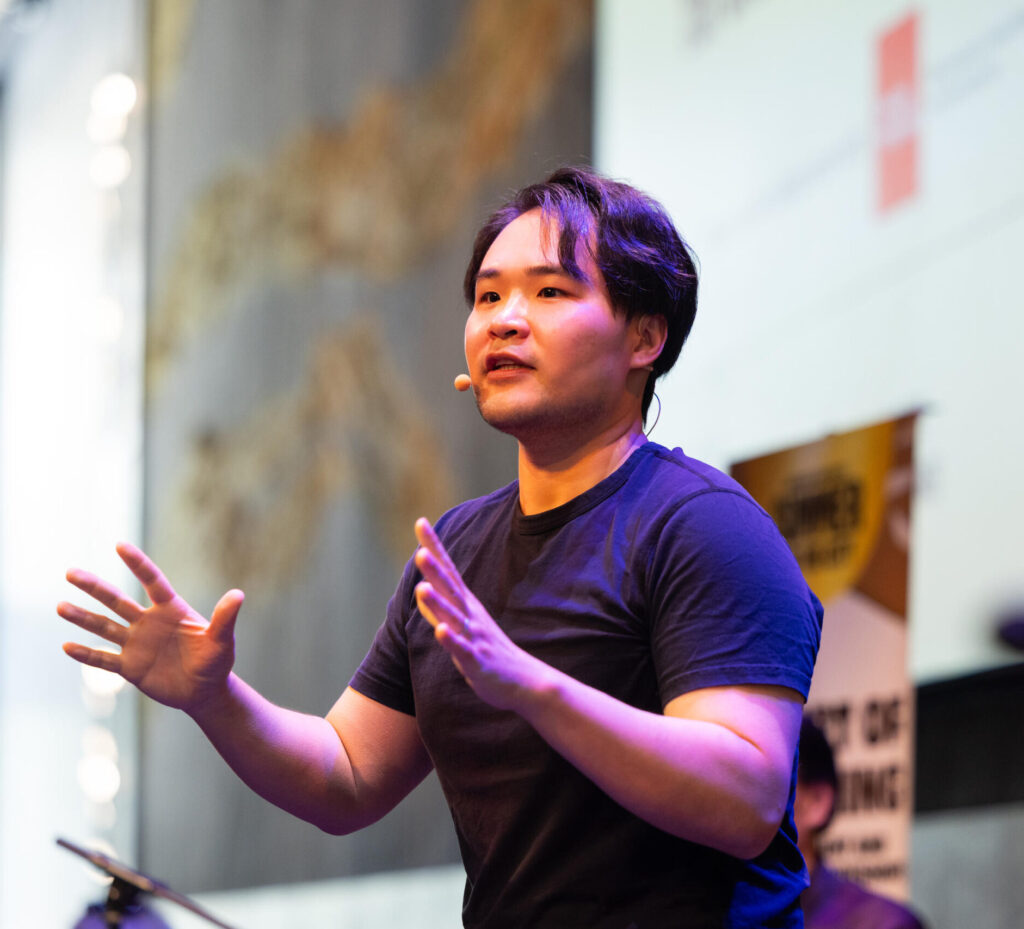
Raymond Lee
Tai Chi Ray
Raymond Lee (Tai Chi Ray) is a Tai Chi teacher, martial arts practitioner, and writer who has been teaching and sharing Tai Chi in New York since 2017. He began practicing martial arts at the age of seven and grew up in a family with more than five generations of involvement in Traditional Chinese Medicine. Ray explores Tai Chi through structure, coordination, awareness, natural movement, and the integration of body and mind. His work seeks not only to preserve traditional principles, but to make them understandable and meaningful in contemporary life.