JOURNAL · LEARNING & PRACTICING TAI CHI
A mirror can show you what a Tai Chi movement looks like. But Tai Chi eventually asks for something more difficult: Can you know where your body is, how it is aligned, and what it is doing without constantly looking at yourself?
IN THIS ARTICLE
Do You Need a Mirror for Tai Chi?
How I Learned Tai Chi Without a Mirror
The Limits of Visual Imitation
Learning Relative Body Position
Proprioception: Knowing Where Your Body Is
When the Whole Body Becomes Your Eyes
Should Beginners Ever Use a Mirror?
From Outside-In to Inside-Out
Do You Need a Mirror for Tai Chi?
No. You do not need a mirror to practice Tai Chi.
A mirror can sometimes be useful, especially when a beginner is trying to understand the general shape of a new posture. But becoming dependent on a mirror can also hide one of the most important skills Tai Chi is trying to develop: the ability to sense your own body from within.
In the traditional way I learned Tai Chi, the question was not simply:
“Does my movement look right?”
The deeper question was:
“Can I feel whether my body is in the right relationship?”
Those are not the same thing.
A movement can look graceful from the outside while its internal structure, balance, coordination, or intention is very different from what the practitioner believes it to be.
In Tai Chi, we gradually move from asking “How do I look?” toward asking “How does my body feel?”
How I Learned Tai Chi Without a Mirror
I began learning Tai Chi from my grandfather when I was seven years old. We practiced in a park. There was no studio and, of course, no wall covered with mirrors.
As a child, this bothered me.
I remember complaining that I could not see the front and back of my grandfather at the same time. I also wanted to know whether my arm was at exactly the right height.
His solution was simple.
If I needed to see him from another direction, I could move around him and observe from a different angle. But he did not want my learning to stop at what my eyes could copy.
He told me:
“Eyes can see movements, but only the heart can absorb the intention—Yi (意)—behind the movements.”
I did not fully understand what he meant when I was seven. But the sentence stayed with me.
Years later, I came to understand that he was teaching me something larger than how to position an arm.
He was teaching me not to make vision the center of my Tai Chi practice.
The Limits of Visual Imitation
We naturally learn by watching.
When someone first sees Tai Chi, the most obvious information is visual: the position of the hands, the direction of the feet, the height of the stance, the shape of the posture, and the sequence of movements.
There is nothing wrong with observation. A teacher must demonstrate, and a student must look.
The problem begins when looking becomes the entire method of learning.
If I watch my teacher lift an arm and then make my arm look similar, I may have copied the visible shape. But I still do not necessarily know:
- where my weight is distributed,
- whether my shoulders are unnecessarily tense,
- how my arm relates to my torso,
- whether my movement is connected to the rest of my body,
- whether my balance is stable, or
- what intention gives the posture its direction and meaning.
This is one reason I do not believe that visually beautiful Tai Chi automatically means structurally sound Tai Chi.
The mirror can report the external appearance.
It cannot directly tell you what is happening inside your body.
Learning Relative Body Position Instead of Memorizing a Picture
My grandfather taught me another way to check my movements: use the relationships among different parts of the body.
Take one position in Cloud Hands as a simple example.
Instead of asking me to reproduce a picture in a mirror, he taught me to recognize internal landmarks. One hand might be positioned around the level above the eyebrow while the other is below the navel.
Now the information is not:
“Make your body look exactly like this image.”
It becomes:
“Know where one part of your body is in relationship to another.”
That distinction is important.
Your eyebrow moves with you. Your navel moves with you. Your shoulders, hips, hands, feet, and center all exist in relationship to one another wherever you are standing.
You begin constructing an internal map of your own body instead of constantly referring to an image outside yourself.
The martial intention of the posture also helps explain the position. In this Cloud Hands example, the hand positions are not arbitrary decorations. They relate to protecting vulnerable areas such as the head and groin.
This is where Yi (意) begins to matter.
Yi is often translated as “intention,” although the idea deserves an article of its own. For our purpose here, it is enough to understand that the external shape of a Tai Chi posture is connected to a purpose. When you understand that purpose, the position becomes easier to feel rather than merely memorize.
Proprioception: Knowing Where Your Body Is Without Looking
Modern physiology gives us a useful word for part of what this kind of training develops: proprioception.
Proprioception is our ability to sense the position and movement of our body without needing to see it.
You already depend on this ability every day.
You do not normally have to stare at your feet to know whether one is in front of the other. You can touch your nose with your eyes closed. You can usually tell whether your elbow is bent without looking at it.
Tai Chi gives us an opportunity to refine this internal sense much more deliberately.
As you practice slowly, you can begin noticing questions that are easy to overlook during faster or more automatic movement:
- Where is my weight right now?
- Can I feel the difference between my left and right sides?
- Where are my shoulders in relation to my hips?
- Did my hand move by itself, or did my whole body participate?
- Did my balance change before I noticed it visually?
- Can I sense unnecessary tension before someone else points it out?
A mirror may help you notice some visible errors.
Proprioceptive awareness begins teaching you to notice yourself.
When the Whole Body Becomes Your Eyes
Traditional martial arts also provide a practical reason not to depend entirely on vision.
The real world is not a mirrored studio.
Lighting changes. The ground may be uneven. Your vision can be obstructed. People may approach from different directions. Events can happen too quickly for you to visually analyze every detail before responding.
Even outside martial arts, we encounter similar situations.
You may lose your balance while walking on an uneven sidewalk. A subway or bus may suddenly accelerate. You may turn while carrying something and have to reorganize your balance before you have time to think about it.
The more clearly you sense your own body, the less every adjustment has to begin with your eyes.
This is why I sometimes tell my students:
“Your whole body becomes your eyes.”
This does not mean that vision becomes unimportant.
It means that vision becomes only one source of information.
Your feet feel the ground. Your skin detects contact. Your joints tell you about position. Your sense of balance tells you when your center is changing. Your entire body begins participating in perception.
Should Beginners Ever Use a Mirror?
I would not turn this into a rigid rule that says mirrors are always bad.
That would miss the point.
For a beginner, visual feedback can be useful. A mirror may help you discover that one shoulder is much higher than the other, that your stance is different from what you imagined, or that you misunderstood the broad direction of a movement.
A teacher may also use video or visual demonstration for the same reason.
The question is not whether you are allowed to look.
The question is whether you are becoming dependent on looking.
If you can perform a movement only when facing a mirror, your body has not yet fully learned that movement.
A useful progression is:
- Look — observe the movement carefully.
- Understand — learn its basic structure and purpose.
- Feel — notice the relationships within your own body.
- Test — practice without visual feedback.
- Adapt — maintain the principles when direction, environment, or conditions change.
The mirror can therefore be a tool.
It should not become the teacher you cannot practice without.
From Outside-In to Inside-Out
There is a larger principle behind all of this.
Tai Chi begins with things outside us.
We listen to the teacher. We learn knowledge. We follow instructions. We imitate shapes.
But practice gradually turns inward.
We become aware of weight, tension, balance, breathing, joint relationships, coordination, intention, and the subtle differences between what we think we are doing and what our body is actually doing.
This does not mean abandoning external instruction. A knowledgeable teacher remains important precisely because what feels “normal” is not always efficient or well organized.
But good instruction should gradually make you more capable of sensing yourself—not permanently more dependent on watching someone else.
That is why the absence of a mirror in my childhood Tai Chi practice eventually became meaningful to me.
My grandfather was not simply withholding a convenient teaching tool.
He was directing my attention somewhere else.
From the movement I could see toward the movement I could feel.
From copying the shape toward understanding the relationships.
From the eyes alone toward the awareness of the whole body.
Do not only ask, “Does my Tai Chi look right?” Learn to ask, “Can I feel what my body is doing?”
Conclusion: The Mirror Is a Tool, Not the Goal
So, do you need a mirror to practice Tai Chi?
No.
Use one if it helps you understand something visually. Then turn away from it and see what remains.
Can you still sense your posture?
Can you still find the relationships among your hands, feet, torso, and center?
Can you notice when your balance changes?
Can you move without checking your reflection after every adjustment?
That is where a different kind of Tai Chi practice begins.
The goal is not to become better at watching yourself practice Tai Chi.
The goal is to become better at feeling yourself practicing Tai Chi.
FROM TAI CHI RAY’S NOTES
Second Step: Fundamentals, Fundamentals, Fundamentals
This article grows from an idea I first explored in Tai Chi Ray’s Notes No. 4: if progress in Tai Chi does not simply mean learning more movements, what does “going deeper” actually mean?
CONTINUE READING
What Does Yi (意) Mean in Tai Chi?
If the eyes can copy the shape of a Tai Chi movement, what gives that movement its purpose? Continue with an exploration of Yi (意)—one of the most important and most difficult Tai Chi concepts to translate into English—and discover why intention is what turns an external shape into purposeful movement.
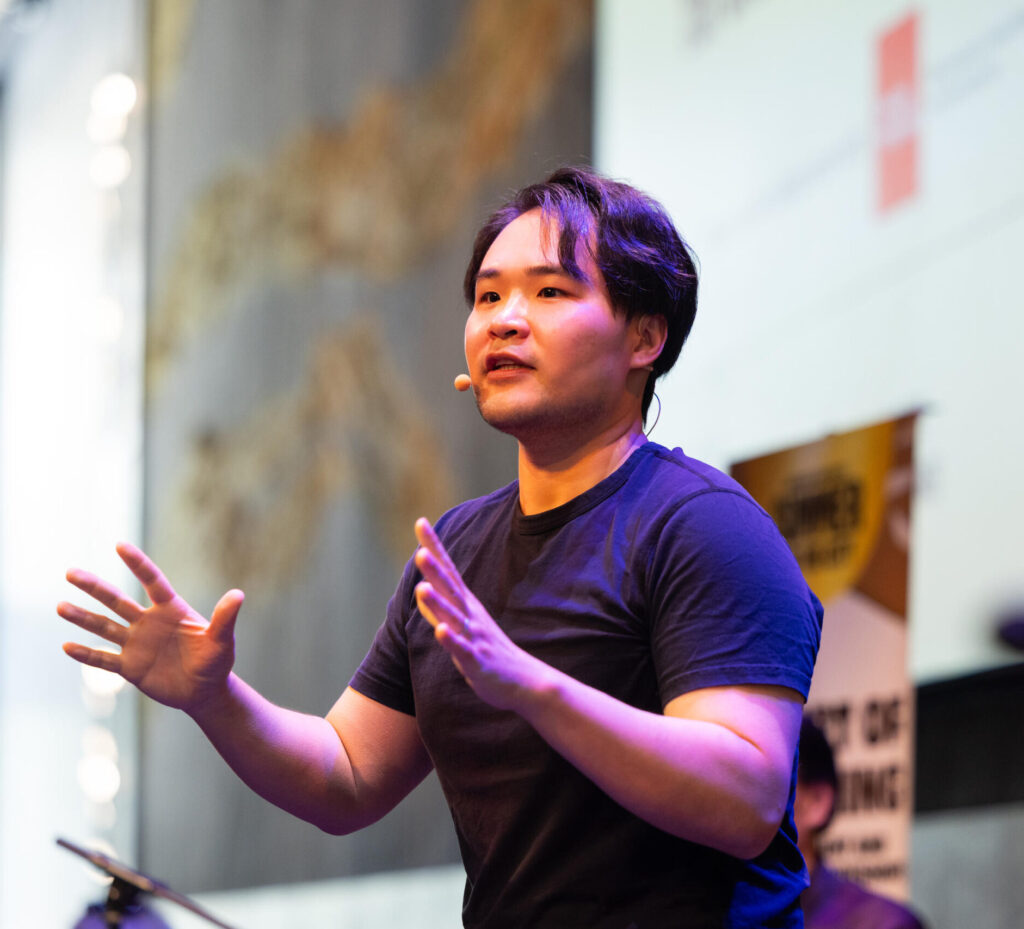
Raymond Lee
Tai Chi Ray
Raymond Lee (Tai Chi Ray) is a Tai Chi teacher, martial arts practitioner, and writer who has been teaching and sharing Tai Chi in New York since 2017. He began practicing martial arts at the age of seven and grew up in a family with more than five generations of involvement in Traditional Chinese Medicine. Ray explores Tai Chi through structure, coordination, awareness, natural movement, and the integration of body and mind. His work seeks not only to preserve traditional principles, but to make them understandable and meaningful in contemporary life.